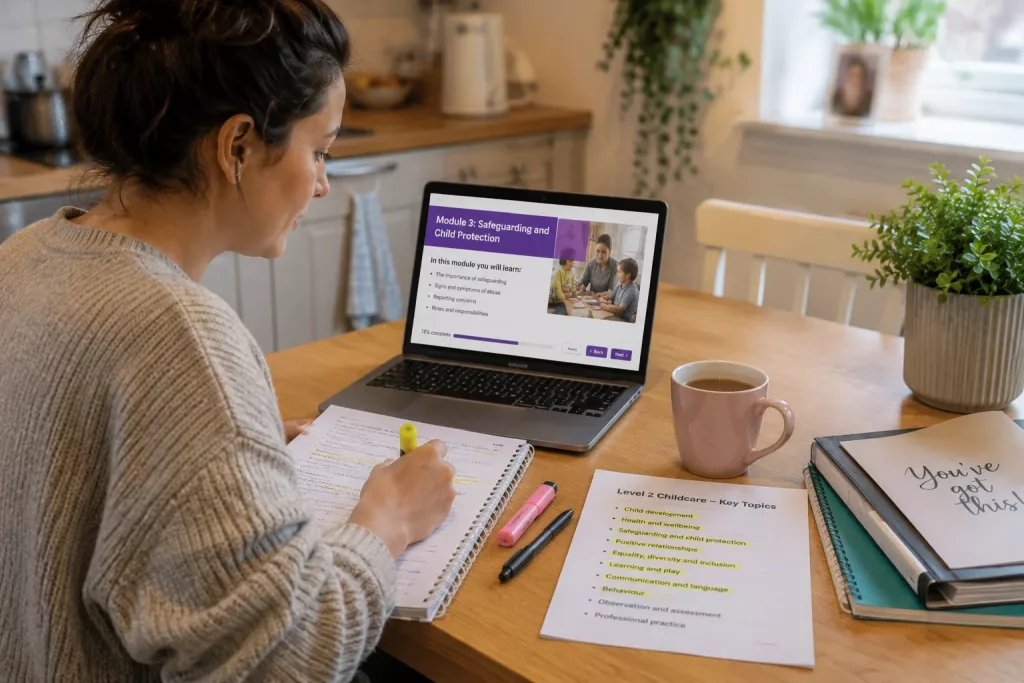

Childcare level 2 revision looks different from traditional exam revision. There are no written papers or timed assessments in a hall. Level 2 Childcare qualifications are assessed through written activities, portfolio evidence, and in some cases, observations in a real setting.
Childcare Level 2 revision is most effective when it reflects how the course is assessed. In Childcare Level 2 revision, explaining your understanding clearly matters more than memorising facts. Always reference legislation by name.
This guide covers: how to write passing answers, which topics matter most for Childcare Level 2 revision, what causes resubmissions, and which free resources are worth using.
Quick Answer: How Is Childcare Level 2 Assessed?
Level 2 Childcare qualifications delivered online are assessed through written activities, unit by unit. For Childcare Level 2 revision, understanding exactly what each criterion requires is what determines whether you pass or are asked to resubmit.
There are no surprise questions. The assessment criteria are published in the qualification specification document, which is available free from your awarding body. For NCFE or TQUK-accredited courses, the specification tells you exactly what each unit requires you to know, understand, and be able to explain.
For the Level 2 Caring for Children and Young People delivered online through My Free Course, assessment is through written activities only. No placement or observation is required.
What Your Tutor Is Actually Marking Against
Every written activity is marked against the assessment criteria in your specification. These criteria use the verb ‘identify’, which means list, ‘describe’, which means add detail, and ‘explain’ means give reasons, ‘analyse’ means examine in depth with evidence. Using the right depth for each verb is the most important aspect of childcare level 2.
Table of Contents
How to Write a Passing Written Assessment Answer
The difference between a passing answer and a resubmission usually comes down to one thing: how directly your answer addresses the specific assessment criterion, not just the general topic.
Step 1: Read the Question Verb First
Before writing anything in your childcare Level 2 revision, identify the instruction verb. ‘Identify’ requires a list. ‘Describe’ requires detail. ‘Explain’ requires reasons and connections. Getting this wrong is the most common cause of resubmission.
Step 2: Address Every Part of the Task
Read the full task before writing. Mark every bullet point or sub-question and address each one in your answer. Tutors mark each component independently in childcare level 2 revision.
Step 3: Add a Specific Example
For any criterion asking you to ‘explain’ or ‘describe’, a specific example strengthens your answer. This applies across all childcare level 2 revision topics. In safeguarding, for example, instead of ‘practitioners should follow safeguarding procedures,’ write ‘practitioners should report a disclosure to the designated safeguarding lead immediately and not investigate independently.’
Step 4: Name the Legislation
Any question involving safeguarding, health and safety, or equality expects you to name the relevant legislation. For childcare level 2 revision, learn these five Acts: Children Act 1989, Children Act 2004, Working Together to Safeguard Children 2023, Health and Safety at Work Act 1974, and Equality Act 2010.
Step 5: Write in Your Own Words
Do not copy text from your study materials or websites. Tutors use plagiarism detection tools. In childcare Level 2revision, writing in your own words demonstrates understanding that copied text does not.
Subject-by-Subject Childcare Level 2 Revision: Key Topics for Each Area
| Topic Area | What to Know | What Examiners and Tutors Look For |
|---|---|---|
| Child Development | Development across key areas: physical, cognitive, language and communication, social, and emotional. Typical milestones from birth through the early years, including gross and fine motor skills, speech and language, and social-emotional development. Factors affecting development include nutrition, environment, genetics, attachment, health, and life experiences. | Know examples of developmental milestones at different ages. Explain holistic development and how the different areas are interconnected. Understand the difference between developmental delay and developmental disorder. |
| Safeguarding and Child Protection | Safeguarding means protecting children from harm and promoting their welfare. Child protection forms part of safeguarding and refers to action taken when a child is at risk of significant harm. Main categories of abuse are physical, emotional, sexual, and neglect. Relevant legislation includes the Children Act 1989, Children Act 2004, and Working Together to Safeguard Children (2023), where applicable. | Know how to respond to a disclosure step by step. Understand the duty of care. Never promise confidentiality. Be able to distinguish safeguarding from child protection and know when concerns must be reported. |
| Health, Safety and Risk Assessment | Health and safety responsibilities within childcare settings, including hazards, risks, and control measures. Risk assessment identifies what could cause harm and how risks can be reduced. Relevant legislation includes the Health and Safety at Work etc. Act 1974 and RIDDOR. | Know the main stages of carrying out a risk assessment. Distinguish between a hazard and a risk. Understand practitioner and employer responsibilities and identify the key legislation. |
| Communication and Language Development | Stages of communication and language development, from early sounds and babbling through first words, two-word phrases, and more complex sentences. Factors affecting communication include hearing, environment, attachment, additional needs, and opportunities for interaction. Strategies include modelling language, repetition, Makaton, PECS, and commentary/parallel talk. | Know the typical language milestones by age. Understand the role of the key person in supporting communication. Know what Makaton is and when it may be used. |
| Inclusion, Equality and Diversity | Equality means treating people fairly according to their needs and legal rights. Equity means providing the support people need to achieve fair outcomes. The Equality Act 2010 protects nine characteristics: age, disability, gender reassignment, marriage and civil partnership, pregnancy and maternity, race, religion or belief, sex, and sexual orientation. | Name all nine protected characteristics. Distinguish equality from equity with an example. Understand direct and indirect discrimination, harassment, victimisation, and reasonable adjustments. |
| Prevent Duty and Online Safety | Prevent is part of the UK’s wider counter-terrorism strategy and is linked to the Counter-Terrorism and Security Act 2015. Practitioners should recognise signs of radicalisation and follow safeguarding procedures where appropriate. Online safety includes age-appropriate use of devices, awareness of online risks, privacy, and confidentiality. | Know the correct safeguarding response if signs of radicalisation are identified. Understand the practitioner’s role in supporting online safety. Follow age-appropriate guidance from your course or setting rather than relying on a single blanket screen-time rule. |
Start your funded Level 2 Childcare course today
The Level 2 Caring for Children and Young People and the Level 2 Certificate in Understanding Common Childhood Illnesses are both available through My Free Course, funded by the Adult Skills Fund for eligible learners in England.
The Six Most Common Reasons for Resubmission in Childcare Level 2 Revision
Understanding resubmission causes is one of the most effective approaches to childcare level 2 revision, because it tells you exactly what to avoid before you submit.
| Common Resubmission Reason | What It Means and How to Fix It |
|---|---|
| Answering the topic, not the question | Read the command verb carefully. “Explain” means give reasons and make links, not just describe. “Identify” means state the correct point briefly rather than writing a long paragraph. A common mistake is writing generally about the topic instead of answering the exact question. |
| Not meeting every bullet point | Read the entire task before you start writing. Tick off each bullet point or sub-question as you complete it. Tutors usually assess each part separately, so missing one section can result in a resubmission. |
| Using general terms without examples | Include a clear example wherever possible. For example, instead of saying “practitioners should communicate with parents”, explain “through daily handover notes”. Practical examples demonstrate understanding. |
| Missing or exceeding the word count | Stay within the stated word limit where one is provided, allowing only a small margin either side. Very short answers often miss assessment criteria, while very long answers can lose focus. If no word count is given, ensure every criterion is covered clearly and concisely. |
| Copying without paraphrasing | Write in your own words rather than copying directly from notes or websites. A useful technique is to read the source, close it, and then explain it from memory in simpler language. This reduces plagiarism risk and demonstrates understanding. |
| Not naming legislation | Questions on safeguarding, health and safety, or equality often expect the relevant legislation to be named. Saying “the law says” is usually not enough. Learn key legislation such as the Children Act 2004, Equality Act 2010, and the Health and Safety at Work etc. Act 1974. |
Free and Official Resources to Support Your Childcare Level 2 Revision
Effective childcare level 2 revision does not require expensive study guides. The table below covers the most useful free resources and one paid option.
| Resources | Where to Find It | What It Covers |
|---|---|---|
| NCFE CACHE Qualification Specification | ncfe.org.uk | Free. The key document for the qualification. It lists the unit titles, learning outcomes, and assessment criteria, making it the best starting point for Level 2 Childcare revision. |
| NHS UK Children’s Health Pages | nhs.uk | Free. Covers childhood illnesses, vaccinations, child development, common health concerns, and general child health information. Useful for health, nutrition, and wellbeing topics. |
| GOV.UK Working Together to Safeguard Children | gov.uk | Free. Statutory safeguarding guidance for England. Useful for understanding safeguarding procedures, reporting concerns, and the wider safeguarding system. |
| NSPCC Learning | learning.nspcc.org.uk | Free. Provides clear safeguarding guidance on abuse, indicators of concern, disclosures, reporting procedures, and practitioner responsibilities. |
| Hachette Learning NCFE CACHE Textbooks | hachettelearning.com | Paid. Official textbooks for NCFE CACHE childcare qualifications. A useful structured study resource if your training provider has not supplied a textbook. |
The Second Course: Level 2 Certificate in Understanding Common Childhood Illness
Why This Course Supports Your Childcare Revision
My Free Courses offers the Level 2 Certificate in Understanding Common Childhood Illness alongside the main childcare course. For Childcare level 2 revision, this course is more than a second credential. It directly reinforces the health and safety knowledge areas that appear in the main qualification.
Health, safety, and nutrition units regularly include questions about childhood illness, infection control, and exclusion periods. The Common Childhood Illness certificate covers these in depth, giving you a stronger knowledge base for your childcare level 2 revision written activities.
What Common Childhood Illnesses Cover
- Common childhood illnesses and their signs and symptoms, including chickenpox, hand foot, and mouth disease, scarlet fever, impetigo, and respiratory infections.
- Infection control principles: how inspections spread, personal hygiene, decontamination procedures, and waste management in childcare settings.
- When to seek medical advice: the signs that indicate a child needs urgent medical attention versus conditions that can be managed within the setting.
- Exclusion periods: the recommended periods for which children should be kept away from the setting following specific illnesses
- Communication with parents and carers about illness: how to inform families sensitively and accurately when a child is unwell
It is delivered entirely online and requires no placement. For learners who find the health and illness sections of childcare level 2 revision particularly challenging, this course provides structured, dedicated coverage of that area.
A Practical Study Tip
If you are working through your childcare level 2 revision and finding the health and safety or nutrition sections difficult, starting the Common Childhood Illnesses certificate alongside your main course is one of the most effective childcare level 2 revision strategies available. Studying the same knowledge area from a different angle deepens understanding and makes the written activities in your main qualification easier to complete.
Frequently Asked Questions (FAQs)
How do I approach childcare level 2 revision for written activities?
Start each childcare level 2 revision session by reading the assessment criteria in your qualification specification. Identify the instruction verb, draft in your own words with a specific example and relevant legislation, then check against each criterion before submitting.
What legislation is essential for the childcare level 2 revision?
The key Acts to know for childcare level 2 revision are: the Children Act 1989, the Children Act 2004, Working Together to Safeguard Children 2023, the Health and Safety at Work Act 1974, the Equality Act 2010, and the Counter-Terrorism and Security Act 2015 (for the Prevent Duty). For each one, know what it covers and what it requires practitioners to do.
My answer was sent back. How do I fix it?
Read your tutor’s feedback carefully. It tells you which criteria your answer did not meet. Redraft only the flagged sections. Adding an example and naming relevant legislation resolves most childcare level 2 revision resubmissions.
Where can I find free childcare level 2 revision resources?
The most useful free resource is your qualification specification, available on your awarding body’s website (ncfe.org.uk for NCFE or tquk.org for TQUK). For safeguarding revision, the NSPCC Learning website and GOV.UK Working Together to Safeguard Children is both authoritative and free. For health topics, NHS UK and the NHS vaccination schedule are reliable sources.
How long should my written activity answers be?
This varies by unit and awarding body. A useful childcare level 2 revision rule: write enough to address every sub-point in the assessment criterion, with at least one example per criterion point. Short answers are usually resubmitted because they are incomplete. Long answers are sometimes resubmitted because they lose focus.
Can I study the common childhood illnesses course at the same time as my Level 2 Childcare course?
Yes. If you’re paying for the course yourself. Both are delivered online at your own pace, and the Common Childhood Illnesses course typically takes 3 to 5 weeks to complete with consistent daily study. Its content complements your Level 2 Childcare studies rather than duplicating them.
However, if your Level 2 Childcare course is government-funded, you can only study one government-funded course at a time. You’ll need to complete your current funded course before enrolling on another.
Disclaimer
Tuition fees for eligible learners are fully funded by the Adult Skills Fund. Some partner colleges may charge an administration fee (typically £50–£100) for registration and certification, but not us. At My Free Course, it’s completely free.
This varies by provider. Eligibility depends on individual circumstances, including age, residency, earnings, and prior qualifications. My Free Course acts as an intermediary between learners and partner colleges. Course availability is subject to change. Geographic exclusions apply. The information in this article is accurate at the time of publication. Adult Skills Fund funding rules, eligibility criteria, and course availability may change over time. Please refer to the latest Adult Skills Fund guidance and myfreecourse.co.uk for the most up-to-date information. This content is provided for informational purposes only and does not constitute legal, financial, or professional advice.