Counselling skills for care workers are one of the most consistently cited development needs across frontline adult social care roles, according to Skills for Care’s 2024 workforce data. The CQC identifies poor communication as one of the most frequently recurring contributory factors in enforcement actions related to dignity and person-centred care.
The gap between the responsibility care workers carry and the counselling skills training they receive is real. Age UK estimates that around 940,000 people aged 65 and over often feel lonely. For many of them, the most consistent human contact in their daily life is with a care worker.
That makes every interaction count. A care worker can ask if someone is alright and receive the answer they expected, not the one the person needed to give. Not because they did not care. Because the conversation did not create a space where a different answer felt safe.
Counselling skills for care workers are not about becoming a therapist. They are about listening with empathy, asking thoughtful questions, and helping people feel heard. Most importantly, these are skills that can be learned, practised, and formally recognised through a nationally accredited qualification.
Short Summary
Counselling skills for care workers are structured communication techniques, including active listening, empathy, open questioning, and boundary management, that support more effective and person-centred interactions. They are not the same as counselling or therapy. They are everyday professional skills that improve how care workers build trust, gather information, support emotional wellbeing, and navigate difficult conversations. The Level 2 qualification in counselling skills provides a formal, assessed foundation in these techniques for adults working in or entering health and social care.
Table of Contents
What Are Counselling Skills for Care Workers?
Counselling skills are structured communication techniques that support meaningful, respectful, and emotionally aware conversations. In care settings, they are used to build rapport, understand a person’s needs more accurately, support people through difficult experiences, and communicate in ways that preserve dignity and trust.
They are not the same as counselling psychotherapy. A care worker applying these techniques is not providing therapeutic intervention. They are applying evidence-based communication principles to their everyday professional role.
The British Association for Counselling and Psychotherapy (BACP) defines counselling skills as a combination of values, ethics, knowledge and communication skills used to support another person‘s emotional health and wellbeing. Within the BACP competence framework, this framework helps professionals recognise when someone needs to talk, respond appropriately to facilitate a safe listening space, and refer sensitively when someone needs further support.
Common Misconceptions
- “Counselling skills are only for mental health roles.”
They apply in every care setting where direct communication takes place. Medication rounds, personal care conversations, end-of-life support, family meetings, and safeguarding disclosures all benefit from this structured approach. - “You either have them, or you do not.”
Counselling skills are not personality traits. Active listening, empathy, reflective questioning, and boundary management are all teachable techniques. A qualification gives them structure and makes them visible to employers. - “They require a counselling qualification to use.”
The Level 2 Counselling Skills qualification is a foundation in communication techniques, not a licence to practise as a counsellor or therapist.
Why Counselling Skills for Care Workers Make a Difference
Most care interactions are also communication interactions. The quality of those communications directly shapes outcomes: whether a person discloses a concern, whether their needs are accurately understood, whether they feel safe, respected, and supported.
Skills for Care’s 2024 workforce data identifies moving and handling, safeguarding adults, and infection control as the most common training areas provided to frontline staff, with 54% of direct care staff not holding a relevant social care qualification in 2024/25. Communication skills are essential for person-centred care and dignity under CQC Regulation 9, where “poor communication or inaccessible information” is identified as a common pitfall that can lead to compliance failures. CQC enforcement actions typically arise from failure to meet care standards, regulation breaches, inadequate governance, staffing concerns, and safeguarding failures.
Why Counselling Skills for Care Workers Matter in Practice
Counselling skills affect outcomes across every level of care: for the person receiving support, for their family, for the care worker themselves, and for the organisation responsible for delivering safe, person-centred care.
Impact on Service Users
When a care worker can listen actively and respond without judgment, people are more likely to disclose concerns early. Early disclosure leads to earlier intervention. NHS research on person-centred communication consistently finds that service users who feel heard report higher satisfaction, greater trust, and improved wellbeing.
Impact on Families
Family members of people in care frequently cite communication quality as the most important factor in their confidence in a care setting. Counselling skills give care workers the tools to hold difficult conversations with families, acknowledge concerns without becoming defensive, and communicate with clarity. This is particularly significant in dementia care, end of life settings, and situations where a family member disagrees with a care plan.
Impact on Care Workers
Care workers who use counselling skills report greater confidence in supporting service users’ emotional health and wellbeing. Understanding how to manage emotional boundaries, use empathy without absorption, and communicate effectively in difficult situations can reduce the personal cost of emotionally demanding work.
Skills for Care’s 2024 workforce data shows the adult social care workforce is growing (+3.4% in filled posts, now 1.6 million), but not fast enough to meet demand, with just 54% of direct care staff not holding a relevant social care qualification. Common challenges contributing to turnover include staffing shortages, workload pressures, and workforce development needs. The BACP counselling skills framework helps professionals support others’ emotional health while working within legal, ethical, and professional guidelines.
Impact on Organisations
Communication failures drive complaints, safeguarding incidents, and CQC concerns. The CQC’s Responsive key question specifically assesses whether people receive care tailored to their individual needs and communicated appropriately. A workforce trained in these techniques is better positioned to meet this standard.
Key Counselling Skills for Care Workers to Develop

These are the core techniques covered by the Level 2 qualification. Each one is teachable, practicable, and directly applicable in everyday care interactions.
#1. Active Listening
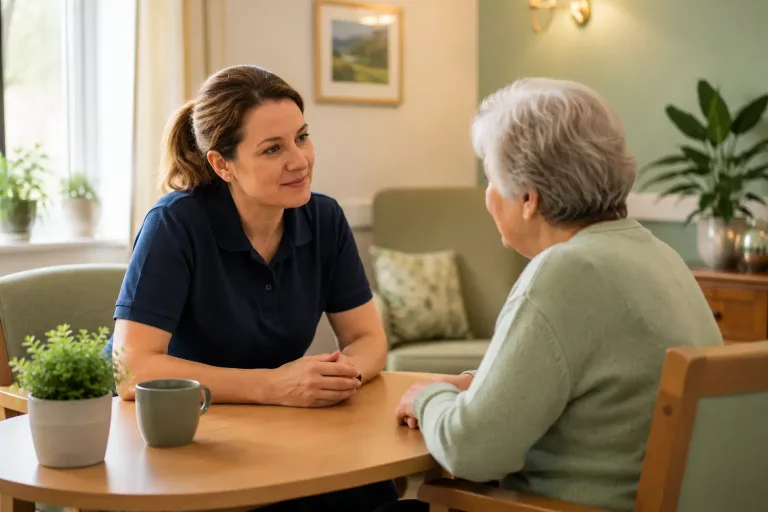
Active listening is the foundation of all counselling skills. It means giving full, undivided attention to what someone is saying, not simply waiting for a pause to respond.
In practice, active listening involves maintaining appropriate eye contact, using non-verbal signals that communicate engagement, not interrupting, and responding in a way that demonstrates you have heard and understood the specific content and emotional tone of what was said.
#2. Empathy
Empathy is the ability to understand and communicate an appreciation of another person’s experience. In care settings, it is expressed through language that validates feelings without making assumptions.
Empathy is not agreement. A care worker can empathise with a resident’s frustration without agreeing that their concern is valid. Communicating empathy does not require resolving the feeling. It requires acknowledging it.
#3. Open and Closed Questioning
Open questions invite a fuller response. They typically begin with “how,” “what,” “tell me about,” or “can you describe.” They are used when more information or emotional expression is needed.
Closed questions invite a “yes or no” response. They confirm specific details and are useful for clarification. Using only closed questions in a sensitive conversation can make a person feel interrogated rather than heard. The skill is in knowing which type to use and when.
#4. Reflection and Paraphrasing
Reflection means mirroring back the emotional content of what someone has said. Paraphrasing means restating the factual content in different words. Both techniques demonstrate that the care worker has listened carefully and gives the person the opportunity to confirm or correct what has been understood.
These techniques are particularly valuable in safeguarding disclosures, emotional distress, and any situation where accuracy matters as much as compassion.
#5. Appropriate Silence
Silence is one of the most underused tools in care communication. Allowing a pause after someone has spoken gives them space to continue, to think, or to say something they were initially hesitant to share.
Many care workers feel the need to fill the silence quickly. In emotionally charged conversations, this instinct, however well-intentioned, can close down communication at the exact moment it was about to open up.
#6. Professional Boundaries
Using counselling skills does not mean absorbing a person’s emotional experience or extending the relationship beyond a professional context. Boundaries protect both the person receiving care and the care worker providing it.
A care worker with good boundary skills can be genuinely present and empathetic without taking on emotional responsibility that belongs to another professional. Knowing when to refer and how to do so compassionately is part of the skill set.
What the Level 2 Counselling Skills Course Teaches
The Level 2 Counselling Skills course introduces the essential techniques used in health, social care, and support roles. It covers both the theory behind each skill and how to apply it in practice.
The course covers the full framework: active listening, empathy, non-judgmental communication, open and closed questioning, reflection and paraphrasing, the use of silence, summarising, and appropriate self-disclosure. It also covers ethical practice, confidentiality, professional boundaries, and when and how to refer to other professionals.
Assessment is coursework-based throughout. There are no exams. Learners work through materials, complete written activities, and submit work for tutor review. Feedback is provided at each stage, with the opportunity to resubmit where needed. Most learners complete the course in 6 to 12 weeks of part-time study.
Common Mistakes When Using Counselling Skills in Care
Most of these errors come from good intentions applied without structure. Knowing what not to do is as important as knowing what to do.
- Offering Reassurance Instead of Validation
Telling someone “I am sure it will be fine” or “try not to worry” is a common response to distress. It is also one of the most common ways of communicating that you have not heard the concern. Validation means acknowledging the specific feeling: “That sounds really frightening.” It does not make a promise. It communicates that the feeling has been heard. - Asking Too Many Questions at Once
Asking multiple questions in rapid succession, particularly after a disclosure, can feel overwhelming and interrogative. One question at a time, with space to respond, is more effective and more human.
- Taking Over the Conversation
Care workers who are genuinely caring often want to help by sharing their own experience or advice. In most counselling-skills interactions, this shifts the focus away from the person and reduces rather than increases the quality of support. - Crossing Professional Boundaries
Providing emotional support is not the same as becoming a confidant or personal advisor. Care workers who blur this line, even with good intentions, risk creating dependency, confusion about roles, and situations they are not equipped to manage. - Best Practice
Prepare before emotionally demanding conversations where possible. Use simple, clear language. Follow up. Document accurately. Know when to refer.
Who Should Take This Course?
There are no formal entry requirements. The Level 2 Counselling Skills qualification is designed for a broad range of people working in or moving toward health and social care roles.
- Care Workers
Any care worker who has direct contact with the people they support will benefit. The skills covered are applicable across every care interaction, not only in specialist contexts. - Support Workers
Support workers in learning disability, mental health, and community settings use counselling skills in almost every shift. This course gives those skills formal structure and recognition. - Healthcare Assistants
Healthcare assistants in NHS and private settings frequently encounter patients in emotional distress, fear, or uncertainty. The ability to respond with structured empathy and appropriate communication is directly relevant.
- Family Carers
Caring for a family member, particularly one with dementia, a learning disability, or a mental health condition, places significant emotional demands on the carer. This course supports family carers in managing those demands more effectively. - Career Changers
For people moving into health and social care from other sectors, the Level 2 Counselling Skills qualification provides a recognised foundation that demonstrates readiness for person-centred work.
Is This Course Worth It?
For care workers already in the sector, the return is immediate. The skills are applied on the next shift. The qualification adds a verified credential that did not previously exist on the CV.
For those entering the sector, it signals something specific to employers: that you understand person-centred communication is a skill, not a personality trait, and that you have invested in developing it formally.
For organisations, it contributes to CQC compliance, reduces communication-related complaints, and builds a workforce better equipped to manage the emotional demands of care work. The administration fee, typically £50 to £100, is the only direct cost for eligible learners. The tuition is funded.
Progression from Level 2 Counselling Skills typically leads into Level 3 qualifications in counselling, mental health, or social care, as well as into senior support, key worker, and team leader roles where communication competence is a core expectation.
Next Steps
The Level 2 Counselling Skills qualification is fully online, self-paced, and assessed through coursework. There are no exams and no fixed session times. Most learners complete the course in 6 to 12 weeks of part-time study.
Tuition is funded through the Adult Skills Fund for eligible learners in England. Some partner colleges charge an administration fee of typically £50 to £100.
Frequently Asked Questions (FAQ)
What are counselling skills for care workers?
Counselling skills for care workers are structured communication techniques, including active listening, empathy, open questioning, reflection, and boundary management, that support more effective and person-centred care interactions. They are not the same as counselling or therapy. They are professional skills applied within a care role to improve how workers communicate, build trust, and support the people they work with.
Is the Level 2 Counselling Skills course the same as a counselling qualification?
No. The Level 2 Counselling Skills qualification provides a foundation in communication techniques drawn from counselling practice. It does not qualify you to practise as a counsellor or therapist. It qualifies you to apply counselling-informed communication skills within your existing professional role. Progression to counselling practice typically requires Level 3 and Level 4 qualifications and supervised practice hours.
Do I need any prior qualifications to enrol?
No. There are no formal entry requirements for the Level 2 Counselling Skills course. It is designed for adults entering the care sector, those already working in care who want to formalise their communication skills, and anyone who works in a role involving direct support of others.
How is the course assessed?
The course is assessed through coursework. There are no formal exams. You work through learning materials, complete written activities, and submit work for tutor review. Tutors provide feedback, and learners have the opportunity to resubmit where something needs to be developed. Assessment is ongoing throughout the course rather than concentrated at the end.
How does this qualification support CQC compliance?
The CQC’s Responsive key question assesses whether people receive care tailored to their individual needs and communicated appropriately. Counselling skills directly underpin the communication competencies that inspectors assess. A documented, regulated qualification in counselling skills provides evidence of formal training that can be presented during inspection.
Can I study this course while working full-time in care?
Yes. The course is fully online and self-paced. There are no fixed session times or classroom attendance requirements. Most learners study in short sessions of 20 to 30 minutes, fitting around shift patterns, caring responsibilities, and everyday commitments. The course is specifically designed for working adults.
What roles does this qualification support progression into?
The Level 2 Counselling Skills qualification supports progression into senior care worker, key worker, mental health support worker, and learning disability support worker roles. It is also a recognised stepping stone toward Level 3 qualifications in counselling, mental health, and social care.
Disclaimer
Tuition fees for eligible learners are fully funded by the Adult Skills Fund. Some partner colleges may charge an administration fee (typically £50-£100) for registration and certification, but not us. At My Free Course, it’s completely free.
This varies by provider. Eligibility depends on individual circumstances, including age, residency, earnings, and prior qualifications. My Free Course acts as an intermediary between learners and partner colleges. Course availability is subject to change. Geographic exclusions apply. This content is for informational purposes only and does not constitute legal or professional advice. Visit MyFreeCourse.co.uk for the most current course and eligibility information.