Infection control training is a critical part of protecting patients and reducing the spread of healthcare-associated infections across England’s health and social care settings. Healthcare‑associated infections affect an estimated 300,000 patients in England each year, based on older UK‑wide modelling. Current surveys show that around 7–8% of patients in English healthcare settings have a healthcare‑associated infection on any given day, with these infections often extending hospital stays, worsening existing conditions, and contributing to death in the most vulnerable.
Most of them are preventable.
The single most effective intervention is not a new piece of equipment or a revised policy. It is a well-trained care worker who understands how infection spreads and what stops it. Every hand-washing decision, every correct use of PPE, every properly cleaned surface represents infection control in practice.
The problem is that many care workers learn infection control through observation rather than structured training. They absorb habits from colleagues, some good and some not, without ever being taught the evidence base behind them. The result is inconsistent practice across a team. Inconsistency is what infection exploits.
The Health and Social Care Act 2008 Code of Practice requires all registered providers in England to ensure their staff are appropriately trained and competent in infection prevention and control. This is a legal requirement, not a recommendation. Providers who cannot demonstrate compliance face enforcement action from the Care Quality Commission.
This article explains what infection control training covers, why it matters for individual care workers and for the services they work in, and how eligible learners in England can access a funded Level 2 qualification at no tuition cost.
Quick Answer
Infection control training helps care workers understand how infections spread and how to prevent them, and how to respond when an outbreak occurs. It is a core competency requirement in UK health and social care and is assessed directly by the CQC. For care staff and providers, this is not optional knowledge. It is foundational.
Table of Contents
What Is Infection Control Training?
Infection control training teaches care workers how to prevent the spread of infection in health and social care settings. It covers how infections develop and spread, the hygiene practices that reduce risk, the correct use of protective equipment, and the steps to take when an infection is confirmed or suspected.
For care workers, this knowledge is applied every single day. Every time you wash your hands between tasks, dispose of clinical waste, clean equipment, or use PPE correctly, you are practising infection control. Training gives those actions a formal, evidence-based foundation.
Infection control training is relevant to any care worker who has direct contact with the people they support, handles clinical waste, manages medication, or works in a shared living environment. This covers the vast majority of frontline roles in adult social care. It is also directly relevant for domiciliary care workers, who move between multiple households and carry a particular responsibility for not transmitting infection between clients.
The Scale of the Problem: Healthcare-Associated Infections in the UK
Healthcare‑associated infections add a substantial number of extra bed days to NHS care each year, representing a major burden on capacity and cost. Current UK‑wide prevalence surveys show that HCAIs are present in around 7–8% of patients on any given day in English healthcare settings. Care homes are particularly high‑risk environments because residents are often elderly and immunocompromised and live in close proximity to others. Influenza, other respiratory infections, gastroenteritis, and skin infections spread rapidly in these settings.
The COVID‑19 pandemic made this risk visible at scale: between March 2020 and April 2021, care homes in England reported hundreds of thousands of COVID‑19 cases among residents and staff.
Neglect and acts of omission account for the largest share of adult safeguarding enquiries in England, with infection‑control failures often contributing, usually through inconsistent training and unclear practice standards rather than malicious intent. Well‑trained staff are consistently identified in the evidence base as the single most effective intervention in preventing the spread of infection, which is why infection‑control training is embedded in every major workforce standard for the sector.
What Does Infection Control Training Cover?
The Level 2 Principles of the Prevention and Control of Infection in the Health Care Setting provides thorough, practical grounding across the following areas.
- The chain of infection: The chain of infection is the model used to understand how an infection moves from a source to a new host. It has six links: the infectious agent, the reservoir, the portal of exit, the mode of transmission, the portal of entry, and the susceptible host. Breaking any one of these links prevents the infection from spreading. Training teaches you to identify where each link is in a given situation and what action breaks it. This is the conceptual foundation that makes every practical measure make sense rather than just being a rule to follow.
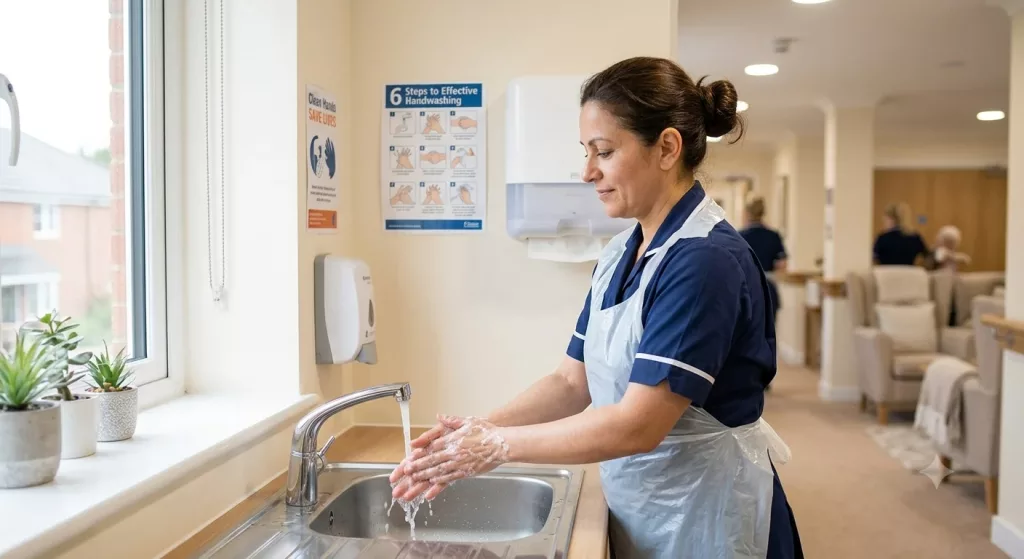
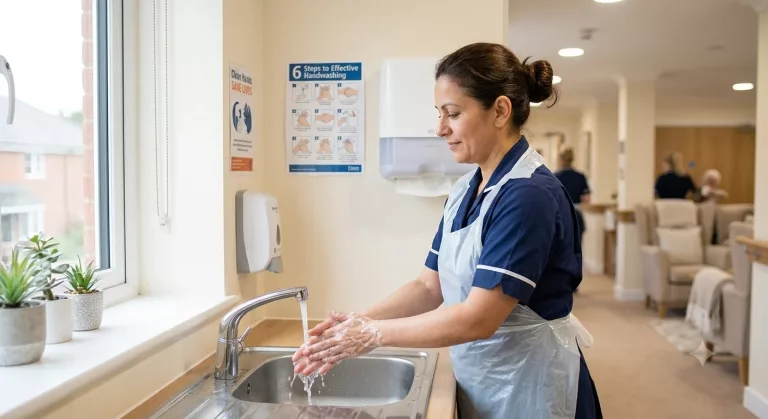
- Hand hygiene: Hand hygiene is widely regarded as the single most important measure in preventing the spread of infection in healthcare settings. The WHO’s Five Moments for Hand Hygiene provide the standard framework: before touching a patient, before a clean or aseptic procedure, after a body‑fluid exposure risk, after touching a patient, and after touching the patient’s surroundings. The course covers the correct technique for both handwashing and alcohol‑based hand rub, and when each is appropriate. Alcohol‑based hand rubs are highly effective for most pathogens but are less effective against non‑enveloped viruses such as norovirus and spore‑forming bacteria such as Clostridioides difficile, where soap and water is the preferred method. National audit data from the UK and other countries consistently show that hand hygiene is performed correctly in well under 90% of observed opportunities, with many settings reporting compliance below 70% in some audits. Training directly addresses this gap by embedding WHO‑aligned practice into routine care.
- Personal protective equipment. The course covers which types of PPE are used in care settings, when each is required, and how to don and doff PPE safely. The doffing sequence is particularly important, as incorrect removal is one of the primary ways care workers contaminate themselves after using PPE. PPE covered includes gloves, aprons, fluid-resistant surgical masks, eye protection, and full-face shields.
- Decontamination and waste management: Decontamination covers cleaning, disinfection, and sterilisation of equipment and environments. The course distinguishes between these three levels and explains when each is required. Clinical and hazardous waste must be segregated, stored, and disposed of in compliance with HTM 07-01 and the Environmental Protection Act 1990. Incorrect waste disposal creates infection risk and regulatory liability.
- Reporting and isolation procedures: When an infection is identified or suspected, the response must be prompt and systematic. The course covers how to identify reportable infections, when and how to initiate isolation, how to communicate with management and other health professionals, and how to document accurately. It also covers outbreak management principles, including when to involve external agencies such as the local health protection team.
CQC Requirements and Infection Control
The CQC assesses infection prevention and control under the Safe key question. Since the introduction of the new assessment framework in 2023, infection prevention and control have formed part of the Quality Statement on Safe Environments. Providers must demonstrate not just that policies exist, but that they are implemented consistently and that staff can articulate their own responsibilities.
During an inspection, assessors look for evidence that the provider has an up-to-date IPC policy, that all staff have received training appropriate to their role, and that the environment and equipment are clean and well-maintained. Inspectors also observe practice directly. A single observed lapse can trigger a deeper investigation and contribute to an adverse rating.
CQC’s 2023/24 State of Care report identified infection prevention and control as a recurring theme in services rated Inadequate, appearing in over a third of the most serious enforcement actions issued in that period.
A poor infection control rating carries real consequences. It contributes to a Safe rating of Requires Improvement or Inadequate. Enforcement actions can include requirement notices, warning notices, conditions on registration, and, in serious cases, suspension or cancellation of registration. A single norovirus outbreak can result in ward closures, staff sickness absence, increased agency costs, family complaints, and legal action. The cost of training is negligible compared to the cost of an outbreak.
Why This Matters for Care Home Managers and HR Leads
For managers and HR leads, infection control training is not a box to check. It is a workforce risk management tool with direct operational implications.
Care providers have a legal duty of care to both the people they support and their staff. If an infection outbreak occurs and an investigation finds that staff were not adequately trained, the provider faces significant legal exposure. Insurers increasingly require evidence of up-to-date infection control training as a condition of cover. Commissioners and local authority contracts also increasingly specify IPC training as a contract condition.
Formal training creates a consistent baseline across a team. It gives care workers the confidence to challenge practices they know to be unsafe, including the confidence to raise concerns about a colleague’s technique or about environmental standards. That confidence is a direct patient safety benefit.
The Level 2 qualification is available with tuition fully funded through the Adult Skills Fund for eligible learners in England. Some partner colleges charge an administration fee of between £50 and £100. This is a fraction of the cost of any equivalent in-house or external training programme.
How to Access Funded Training
The Level 2 Principles of the Prevention and Control of Infection in the Health Care Setting is fully online and self-paced. There are no fixed study times, no classroom attendance, and no exams. Assessment is coursework-based throughout.
The course covers all the areas described in this article: the chain of infection, hand hygiene, PPE, decontamination, waste management, and outbreak response. It is awarded by a regulated awarding organisation and listed on the national qualifications register.
Most learners complete the course in 6 to 12 weeks of part-time study, fitting modules around existing shift patterns. Progress happens in small, realistic windows, not in long, uninterrupted sessions.
Tuition funded for eligible learners. Some colleges may charge an admin fee of typically £50 to £100. Eligibility depends on age, residency, earnings, and prior qualifications.
Frequently Asked Questions
Is infection control training a legal requirement for care workers in England?
Yes. The Health and Social Care Act 2008 Code of Practice requires registered providers to ensure that staff are appropriately trained and competent in infection prevention and control. This applies to all care workers with direct contact with the people they support.
What is the difference between cleaning, disinfection, and sterilisation?
Cleaning removes visible dirt and organic matter. Disinfection reduces the number of organisms to a safe level but does not eliminate all of them. Sterilisation destroys all living organisms and their spores. The level of decontamination required depends on the risk associated with the item or surface. The course covers when each level is appropriate.
Will this qualification count towards CQC compliance?
Yes. A nationally recognised Level 2 qualification in infection prevention and control provides documented evidence that a care worker has received and been assessed on structured training. This is directly relevant to CQC’s assessment of IPC competence across a provider’s workforce. Always confirm with your manager what documentation your specific inspection framework requires.
Can domiciliary care workers access this training?
Yes. Infection control is as relevant in community settings as in residential ones. The course content applies across all care settings, and eligibility for funded tuition depends on individual circumstances rather than the type of care role.
How do I know if I qualify for funded tuition?
Eligibility is based on age, residency in England, annual gross earnings, and existing qualifications. Many frontline care workers qualify. The eligibility checker takes a few minutes and gives a clear result.
Disclaimer
Tuition fees for eligible learners are fully funded by the Adult Skills Fund. Some partner colleges may charge an administration fee (typically £50-£100) for registration and certification, but not us. At My Free Course, it’s completely free.
This varies by provider. Eligibility depends on individual circumstances, including age, residency, earnings, and prior qualifications. My Free Course acts as an intermediary between learners and partner colleges. Course availability is subject to change. Geographic exclusions apply. This content is for informational purposes only and does not constitute legal or professional advice. Visit MyFreeCourse.co.uk for the most current course and eligibility information.