A Level 2 Childcare apprenticeship is not the same as an online childcare course. The two are often confused by people researching routes into early years work, and that confusion matters because they work in completely different ways, suit different situations, and lead to different outcomes.
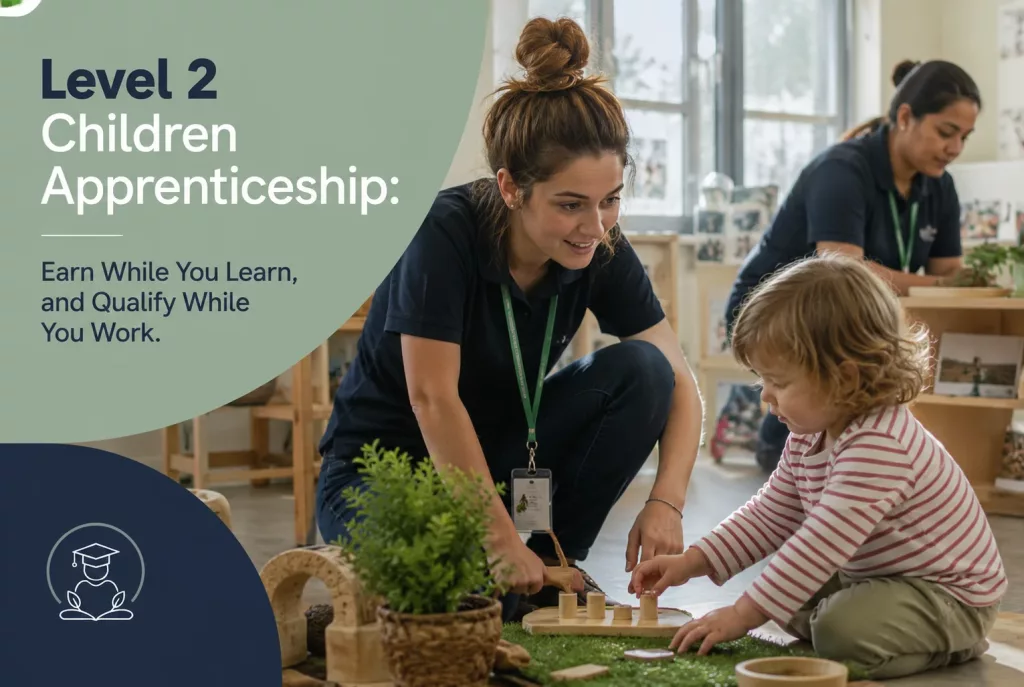
An apprenticeship requires an employer. You work in a nursery or early years setting from day one, receive a wage, and study toward your qualification alongside your job. An online course requires no employer. You study independently, at your own pace, from home.
This guide explains exactly what a Level 2 Childcare apprenticeship involves, what changed when the standard was revised in August 2025, what you can expect to earn, and how to decide which route is the right one for where you are right now.
Quick Answer: What Is a Level 2 Childcare Apprenticeship?
A Level 2 Childcare apprenticeship is a work-based training programme that leads to the Early Years Practitioner (Level 2) qualification. You are employed by an early years setting, typically a nursery, pre-school, or children’s centre, and spend most of your working week doing the job while receiving structured off-the-job training from college or a training provider alongside it.
The programme takes a minimum of 12 months and typically runs for 12 to 18 months, followed by a 4-6 week End Point Assessment period. Throughout this time, you are paid at least the national apprenticeship minimum wage, which is currently £7.55 per hour (from April 2025) for apprentices aged 19 in their first year.
Unlike online childcare courses, the Level 2 Early Years Practitioner apprenticeship standard meets the Department for Education’s full and relevant criteria. This means that on completion, you can be counted toward the legally required EYFS staffing ratios as a Level 2 qualified practitioner, something an introductory online course does not provide.
Why This Distinction Matters
Many people searching for a Level 2 Childcare apprenticeship are comparing it to an online Level 2 Childcare course. The key difference is this: the apprenticeship route leads to a full practitioner credential recognised for EYFS ratio purposes. The online course at My Free Course is an entry-level qualification that prepares learners for further study and is a strong starting point, but it is not the same as a completed apprenticeship standard. Both have their place, but they serve different purposes.
| ~30,000–35,000 | Ofsted-registered early years settings in England, all of which must meet EYFS staffing ratio requirements. This creates consistent employer demand for qualified Level 2 and Level 3 practitioners across the country. |
Table of Contents
How the Level 2 Childcare Apprenticeship Works
A Level 2 Childcare apprenticeship is structured around three components that run simultaneously throughout the programme.
On-the-Job Learning
Most of your working week is spent in your employer’s setting, working directly with children aged 0 to 5. You carry out the practical responsibilities of the role: supporting play and learning activities, assisting with care routines, observing children’s development, and working under the supervision of more senior practitioners. This is where the bulk of your apprenticeship hours is spent.
Off-the-Job Training
For Level 2 Early Years Practitioner apprenticeships, the government requires a minimum of 300 hours of off-the-job training across the full programme (18-month duration). Off-the-job hours must be delivered during contracted working hours, not in your own time.
End Point Assessment
At the end of the programme, you are assessed by an independent End Point Assessment Organisation (EPAO). The EPA for the Level 2 Early Years Practitioner consists of three components: an observation of your practices in the workplace, followed by a questioning session (50 minutes plus 30 minutes of questioning), a professional discussion underpinned by a portfolio of evidence you have built throughout the programme (one hour with a minimum of 10 questions), and a knowledge test comprising 40 multiple-choice questions. To pass the knowledge test, you must answer at least 26 questions correctly. You must complete all three components to achieve the apprenticeship.
The Gateway Process
Before you can sit your End Point Assessment, you must go through the Gateway. This is a formal stage where your employer, training provider, and you jointly confirm you are ready. The Gateway requires you to have completed the off-the-job training hours, achieved Level 2 in English and Maths (or be on track to complete them), and built your portfolio of evidence. The EPA itself typically takes around 3 months from Gateway to result.
The August 2025 Update: What Changed
A revised Level 2 Early Years Practitioner apprenticeship standard came into effect on 1 August 2025, replacing the previous version for all new apprentice starts. If you have been researching the Level 2 Childcare apprenticeship for a while, some information online may relate to the older standard.
What Is New in the Revised Standard
- The knowledge, skills and behaviours (KSBs) have been updated to better reflect the current needs of the early years sector, with a stronger focus on professional practice, safeguarding, communication, and reflective learning.
- The revised standard no longer mandates a specific qualification as part of the apprenticeship. This gives training providers greater flexibility in how they deliver the programme, although many providers continue to include a recognised childcare qualification.
- The assessment plan has been simplified, with apprentices assessed through an observation with questioning and a professional discussion supported by portfolio evidence.
- The temporary minimum off-the-job training requirement was reduced to 300 hours for apprentices starting between August and December 2025 during the transition period.
- From January 2026, the minimum off-the-job training requirements increase to 370 hours, reduced from the previously proposed 396 hours.
- The apprenticeship continues to meet the Department for Education’s Early Years Practitioner criteria, meaning successful apprentices can count in EYFS Level 2 staff-to-child ratios.
What Has Not Changed
- The programme must still last for a minimum of 12 months.
- Apprentices must still be employed in a setting delivering the Early Years Foundation Stage (EYFS) for children aged 0 to 5.
- Apprentices must still complete an independent End Point Assessment before achieving the apprenticeship.
- Government funding remains available through the Apprenticeship Levy and co-investment arrangements for eligible employers.
Apprenticeship vs Online Course: A Direct Comparison
The table below compares a Level 2 Childcare apprenticeship directly against the Level 2 Caring for Children and Young People online course available through My Free Course. Both are valid routes into childcare, but they are built for different situations.
| Factor | Level 2 Childcare Apprenticeship | Level 2 Caring for Children and Young People |
|---|---|---|
| What it is | A work-based training programme. You are employed by a nursery or early years setting and study toward your qualification while working. | A theory-based online qualification. You study the course independently from home, with no employer or workplace required. |
| Who funds it | Your employer funds it via the Apprenticeships Levy or co-funding. The government pays 95% of training costs. The employer pays 5%. You pay nothing. | Funded by the Adult Skills Fund for eligible learners (aged 19+ on 31 August). You pay no tuition fee. Some colleges charge an administration fee of typically £50 to £100. |
| Employment status | You are employed throughout. You receive a wage from day one, at minimum the apprenticeship rate (currently £7.55 per hour, or National Minimum Wage for your age if higher after year one). | You do not need to be employed to study. You can complete the course whether you are at work or not. |
| Duration | 12 to 18 months, plus a 3-month End Point Assessment (EPA) period. You cannot rush it. The 12-month minimum is set by government regulation. | 8 to 12 weeks with consistent daily study. Self-paced with no minimum duration. |
| What you earn | A wage throughout the apprenticeship. Starting salaries are typically £15,000 to £19,000 per year, depending on the employer and your age. | No income from the course itself. If you are already working, your existing income continues. |
| Qualification gained | Early Years Practitioner (Level 2) apprenticeship standard, plus Maths and English qualifications if not already held. | Level 2 Certificate in Caring for Children and Young People, accredited by NCFE or TQUK. An entry-level qualification that prepares for further study. |
| End Point Assessment | Yes. An independent EPA organisation assesses you through an observation and a professional discussion underpinned by portfolio evidence. | No EPA. Assessment is through written activities reviewed by your tutor throughout the course. |
| Work placement required | Yes. You must be employed in an early years setting delivering the EYFS to children aged 0 to 5 for the full duration. | No. The course is entirely online. No workplace setting is required. |
| Progression | Directly into the Level 3 Early Years Educator apprenticeship, which carries full Early Years Educator status. | Prepares for progression toward a full Level 2 or Level 3 Childcare qualification. A starting point rather than a final credential. |
Not sure which route is right for you?
The Level 2 Caring for Children and Young People is available through My Free Course, which is a funded online course that prepares you for your next step. Check your eligibility in under one minute.
Entry Requirements: What You Need Before You Apply
A Level 2 Childcare apprenticeship has specific entry requirements that differ from an online course. The table below sets them out clearly.
| Requirement | What It Means |
|---|---|
| Age | 16 or over. No upper age limit. |
| Employment | You must have a job offer or be employed in an early years setting that delivers the EYFS for children aged 0 to 5. You cannot start a childcare apprenticeship without an employer. |
| English and Maths | Level 1 Functional Skills in English and Maths at a minimum on entry. You must achieve Level 2 (equivalent to GCSE grade 4) before your End Point Assessment. If you do not already hold these, your training provider delivers them as part of the programme. |
| DBS Check | An enhanced DBS check is required before you begin working with children. Your employer arranges this. |
| Residency | You must live in England and have the right to work. Apprenticeships in Scotland, Wales, and Northern Ireland operate under different frameworks. |
| Not already qualified at Level 2 in EYP | If you already hold a full Level 2 Early Years Practitioner qualification, you cannot typically access a Level 2 apprenticeship in the same standard. |
| Working hours | Your employer must offer you a minimum of 16 hours per week. Most nursery apprenticeship roles are Monday to Friday, typically between 7:30 am and 6 pm on a rota. |
| Off-the-job training | Apprentices must complete 25% of the total programme time (approximately 150–200 hours across a 12–18 month programme) as off-the-job training. This is training delivered by your training provider, separate from your regular day-to-day duties. |
The English and Maths requirement is the one that catches people off guard most often. You do not need to hold GCSE English and Maths at Grade 4 or above before you start. But you must achieve Level 2 in both before your End Point Assessment. If you do not currently have these qualifications, your training provider delivers Functional Skills in English and Maths as part of the programme. This adds to your workload but is built into the programme structure.
What You Will Earn During a Level 2 Childcare Apprenticeship
Wages for a Level 2 Childcare apprenticeship vary by employer, location, and your age. The legal minimum is the apprenticeship national minimum wage, which is currently £7.55 per hour for apprentices in their first year or those aged under 19 (April 2025–March 2026 rate). After your first year, if you are aged 19 or over, you are entitled to the full National Minimum Wage for your age.
In practice, many nurseries offer above the legal minimum to attract apprentices in a competitive market. Looking at live vacancies posted on gov.uk. Find an Apprenticeship in 2025 and 2026, with advertised starting salaries for Level 2 Childcare apprenticeships typically ranging from approximately:
- £13,950 per year at the apprenticeship minimum wage (£7.55/hr × 30 hours per week)
- £18,600 per year for apprentices offered above minimum wage at some employers (£7.55/hr × 40 hours per week)
- Some employers advertise wages above the National Minimum Wage for age, particularly in areas with higher competition for apprentices.
These figures are not guaranteed and vary significantly by employer and location. The wage is always confirmed before you accept an offer, and it is separate from your training costs, which are covered by your employer and the government.
The End Point Assessment: What It Involves
The End Point Assessment is the final stage of a Level 2 Childcare apprenticeship and the point at which your qualification is formally awarded. It is conducted by an independent EPAO (End Point Assessment Organisation), not your training provider or employer.
Component 1: Observation with Questioning
An assessor from EPAO visits your workplace and observes you working directly with children. The observation typically lasts 45 to 60 minutes. After the observation, the assessor asks you questions about what they saw and why you made the decisions you did. This assesses your practical skills and your ability to explain your practice clearly.
Component 2: Professional Discussion
A structured conversation between you and the assessor, lasting approximately 60 minutes. You reference your portfolio of evidence throughout this discussion. The portfolio is not assessed directly, but it underpins and supports your answers during the discussion. The assessor uses the discussion to explore the areas of the standard that are harder to observe in a single workplace visit.
Grades
The EPA is graded as either pass or fail. If you fail, you can resit the assessment (typically once, depending on your provider’s policy). There is a Gateway stage before the EPA where your employer and training provider jointly decide when you are ready. If you are not ready for the EPA, you will not be put forward through the Gateway.
Who Is the Apprenticeship Right For and Who Is It Not?
A Level 2 Childcare apprenticeship is the right route for some people and not the right route for others. The table below is honest about both.
| Your Situation | Better Route | Why |
|---|---|---|
| You do not currently have a job | Online course first | The apprenticeship requires employment in an early years setting from day one. The online course is a more accessible starting point and can prepare you to apply for apprenticeship roles. |
| You have a job offer from a nursery or are already employed in an early years setting | Apprenticeship | You have the employer requirement covered. The apprenticeship gives you a wage, a formal qualification, and a route into a fully practitioner-level credential at Level 3. |
| You want to qualify as quickly as possible | Online course | The online course takes 8 to 12 weeks. The apprenticeship takes 12 to 18 months minimum, plus 3 months for the End Point Assessment (EPA). |
| You want to earn while you qualify | Apprenticeship | The apprenticeship provides paid employment from the first day. The online course does not generate income. |
| You are a parent who wants to understand child development without entering a career | Online course | The online course requires no employer or workplace commitment. The apprenticeship is a career route, not a knowledge course. |
| You want the qualification that counts toward EYFS Level 2 staffing ratios | Apprenticeship | The Early Years Practitioner apprenticeship standard meets the DfE’s full and relevant criteria for Level 2 ratio purposes. The online introductory course does not. |
| You want to progress to Level 3 and Early Years Educator status | Apprenticeship | The Level 2 Early Years Practitioner apprenticeship leads directly into the Level 3 Early Years Educator apprenticeship, which carries full Early Years Educator status. |
What About the Level 2 Caring for Children and Young People Online Course?
If you are reading this guide and realise that you do not currently have an employer, the Level 2 Caring for Children and Young People available through My Free Course is a relevant starting point.
It is an accredited entry-level qualification delivered entirely online, funded by the Adult Skills Fund for eligible learners in England. It covers child development, safeguarding, nutrition, accident prevention, and supporting parents and carers. It is designed to prepare learners for their next steps in childcare, including applying for apprenticeship roles.
It is worth being clear about what this course is and is not. It is not a Level 2 Early Years Practitioner apprenticeship, and it does not provide the same practitioner-level credential. But for someone who does not yet have childcare experience or an employer, it is a practical and funded way to build foundational knowledge, strengthen a job application, and demonstrate genuine interest in the sector before pursuing an apprenticeship.
Many employers who offer childcare apprenticeships value applicants who have already taken the initiative independently. Completing the online course while you search for an apprenticeship role is a constructive use of your time and can make your application stand out.
Using the Online Course as a Stepping Stone
If your goal is a Level 2 Childcare apprenticeship but you do not yet have a job offer in an early years setting, consider starting the Level 2 Caring for Children and Young People through My Free Course while you search for an employer. It demonstrates sector knowledge, covers the foundational topics the apprenticeship builds on, and gives you something concrete to discuss at an interview.
Frequently Asked Questions (FAQs)
Do I need any qualifications to start a Level 2 Childcare apprenticeship?
You do not need GCSEs in English and Maths to start, but you must achieve Level 2 Functional Skills in both before your End Point Assessment. If you do not hold these, they are delivered as part of the programme. You do need a job offer in an early years setting.
Can I do a Level 2 Childcare apprenticeship if I am over 25?
Yes. There is no upper age limit for apprenticeships. Adults aged 25 and over are eligible. The funding model is the same regardless of age: your employer covers training costs through the Apprenticeship Levy or co-funding (5% employer, 95% government).
Who pays for a Level 2 Childcare apprenticeship?
Your employer pays for your training through the Apprenticeship Levy (if they are a large employer) or through co-funding for smaller employers, where they contributes 5%, and the government covers 95%. The total training cost for a Level 2 Early Years Practitioner apprenticeship is typically around £4,000–£6,000 (varies by training provider), of which the employer pays approximately £200–£300 (5%). You pay nothing for training.
What is the difference between the Level 2 Childcare apprenticeship and the Level 3?
The Level 2 Early Years Practitioner apprenticeship is the entry-level route, suitable for people with no prior childcare experience or qualifications. The Level 3 Early Years Educator apprenticeship leads to Early Years Educator status, enabling practitioners to work independently and take on key person responsibilities. Most employers expect practitioners in senior roles to hold a Level 3 or equivalent. Completing the Level 2 apprenticeship is often the gateway to starting the Level 3.
How is the apprenticeship assessed?
Through an End Point Assessment conducted by an independent organisation. The EPA includes a workplace observation with questioning, lasting approximately 45 to 60 minutes, and a professional discussion underpinned by your portfolio evidence, lasting approximately 60 minutes. The EPA is graded as a pass or distinction.
Can I do the online course instead if I cannot find an apprenticeship?
Yes. The Level 2 Caring for Children and Young People is available through My Free Course, which is a funded online alternative for eligible learners who do not yet have an employer in an early years setting. It is an entry-level qualification that covers foundational childcare knowledge and prepares you for further study or employment. It is not a replacement for the apprenticeship, but it is a practical first step if you are still searching for an employer.
Will completing the online course help me get an apprenticeship?
It can. Many nurseries and early years settings view applicants who have already completed an online childcare qualification positively, as it demonstrates genuine interest and some sector knowledge. It is not a guarantee of an apprenticeship offer, but it is a reasonable way to strengthen your application while you search for a suitable employer.
Disclaimer
Tuition fees for eligible learners are fully funded by the Adult Skills Fund. Some partner colleges may charge an administration fee (typically £50-£100) for registration and certification, but not us. At My Free Course, it’s completely free.
This varies by provider. Eligibility depends on individual circumstances, including age, residency, earnings, and prior qualifications. My Free Course acts as an intermediary between learners and partner colleges. Course availability is subject to change. Geographic exclusions apply. This content is for informational purposes only and does not constitute legal or professional advice. Visit MyFreeCourse.co.uk for the most current course and eligibility information.